
Big 12 Championship - For All the Marbles


BYU heads to Arlington with everything still in front of them; a conference title, a chance to validate an 11–1 season, and maybe even a way to force themselves into the playoff discussion. It’s a stage the Cougars haven’t been on in a long time, and one that arrives at the perfect moment, because the narrative swirling around this team for the last month has been one of quiet frustration.
You’ve seen the playoff graphics. You know the story. BYU keeps winning, keeps stacking a resume that would normally sit comfortably in the top ten, and yet the committee treats them like a guest who showed up without an invitation. A virtually identical record to #6 Ole Miss (Ole Miss 7 SOR, 12 FPI, 40 SOS, 10 GC, 1-1 vs current top 25 - BYU 6 SOR, 15 FPI, 35 SOS, 14 GC, 2-1 vs current top 25) none of it has moved the needle enough to push them past two-loss brands with shinier logos on their helmets. Every Tuesday has been another reminder that BYU has to shout a little louder than everyone else just to be heard.
This weekend is their chance to stop shouting and force the committee's hand. Standing in the way is a Texas Tech team that has spent three months turning the Big 12 into a highlight reel of explosive passes with crushing run defense, and also gave BYU a humbling loss less than a month ago. If BYU wants to change the conversation, they’ll have to beat the one opponent in the league that shut the Cougars down this season. Win, and the committee has no choice but to take them seriously. Lose, and the season becomes one of those painful stories about what might have been.
Texas Tech at a Glance
The bad news for BYU fans is that we got to see the Red Raiders defense first hand. They look every inch the part of the nations #1 defense. It’s an identity that feels almost strange for a program long associated with shootouts, but this group has flipped the script. The Red Raiders spent the off season buying elite defensive talent out of the transfer portal and it's paid off big this season. They haven't needed luck or gimmicks to win games, though that hasn't stopped them from using trick plays like a fake punt last week while up 42 points. They’re winning because their defense is a brick wall that offenses have found nearly impossible to crack.
Start with the run defense, because that alone tells the story. Three of four availabe spots on the All Big-12 First Team defensive line went to Texas Tech, and the fourth starter on the Red Raiders defensive line was named to the All Big-12 Third Team. Allowing just 71.2 rushing yards per game in a power conference is unheard of, and the film matches the numbers. Their front doesn’t just win at the line - it overwhelms it. Opponents don’t get movement, they don’t generate cutback lanes, and they rarely see second-level space. The advanced stats make it even clearer: a 29% defensive success rate and a –0.095 EPA allowed mark a unit that is not merely disruptive, but disciplined and suffocating. I said last time that no-one has consistently run the ball on them this season. That still holds true. What makes the defense so difficult is the breadth of what they take away. They’re elite against the run, but they’re also extraordinarily sharp in situational football. Opponents are converting barely 30% on third down, and once you get into the red zone, their front tightens even more.
Against that backdrop, the offense almost feels like a luxury feature, but it’s a dangerous one. Texas Tech’s offense is built around Behren Morton. He’s completing nearly 68% of his passes, owns a 165.9 passer rating, and is so good on third down that it almost feels unfair. His 193.59 passer rating on third down is the core of Tech’s identity on offense: they don’t need to dominate every play, because Morton is lethal in third and long when he has time in the pocket. They’re not quite as explosive as some of the high-octane Tech teams of the past, but they’re absolutely effective. At nearly 490 yards per game, with a balanced scoring profile, and a knack for hitting timely chunk plays, the offense is good enough to beat you on its own, but the defense is good enough to make sure it rarely has to.
Put it all together, and Texas Tech becomes one of the most complete teams in the country. They have a quarterback who extends drives, a scheme that stresses defenses, and a defensive front that looks like it was assembled in a fantasy league. When they control the line of scrimmage, which they usually do, they are a national championship caliber team.
The Rematch
BYU has played perhaps their best football of the season since the loss in Texas. They absolutely dominated TCU at home the next week, the exact bounce back response we all hoped to see. They went on the road to Cincinnati and had a convincing two score win against one of the best teams in the conference, and then finished the season with another crushing win 41-21 over UCF (5-7) - a much larger margin than Alabama's 27-20 win over Auburn (5-7) that earned the Crimson Tide a move up in the CFP poll.
At the end of the day, the score board is all that matters, and the scoreboard showed a three score loss in round one. In terms of understanding how well BYU actually matches up against Texas Tech, however, it's worth looking beyond the scoreboard to see where things fell apart and where things went well.
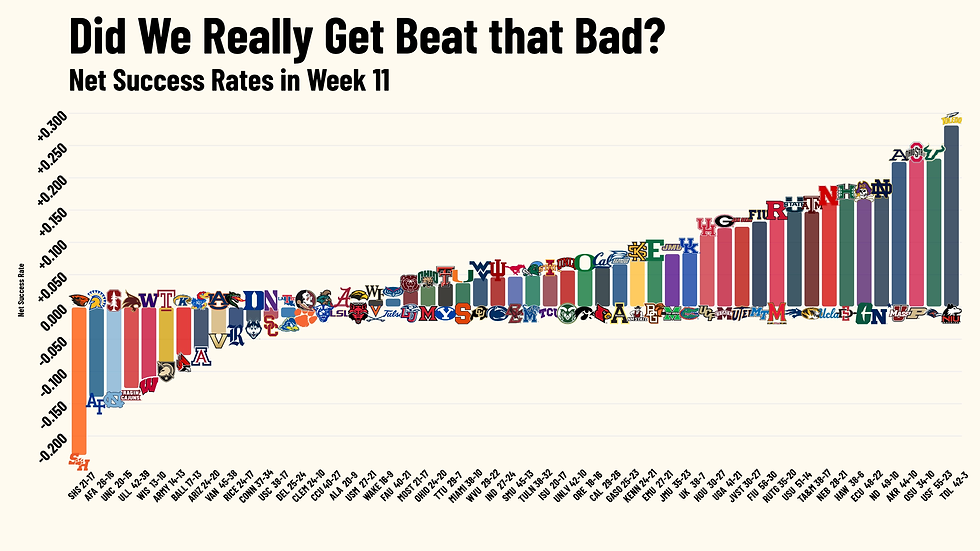
I've seen fans disparage this graphic and net success rate and I think there's a misunderstanding of what the stat is telling us. The title of the graphic is misleading and this isn't a great indicator of the final score. Net success rate is a comparison of how well teams moved the ball against each other across the whole game. The game is won and lost on the one off plays - an explosive pass, a turnover, not converting in the red zone. With this view we are ignoring the fumble deep in BYU's territory on a punt return, the other one off big plays, and just looking at down to down success moving the ball. There wasn't a huge disparity in this game, despite LJ Martin clearly not being anywhere near full strength! This is important because between the twenties they really weren't moving the ball better than we were.
BYU ran a different offense in this game then they have for most of the season, relying on max protect to try to give Bear more time in the pocket. Frankly, it didn't work. BYU's only points in the game came on a drive where we abandoned max protect and had more players out on routes, giving Bear somewhere to go quickly with the ball.
The first major turning point for BYU was turnovers, with 3 in the first matchup. It's also the only game this season without forcing a turnover. Teams that are -3 in the turnover margin only win ~7% of the time. The turnovers, combined with a couple of shanked punts, also gave Texas Tech a massive advantage on starting field position, with an average starting field position of their own 41 yard line vs BYU starting at their own 23. With an 18 yard advantage in average starting field position, Texas Tech had a much higher upside in expected points per drive at +2.2.
For the rematch to go differently, the offense needs to better protect the football and special teams needs to avoid miscues. Evening out the starting field position by avoiding (and forcing a few!) turnovers and getting good punts would already put the teams on even footing without needing a miracle big play.
The Advanced Stat Stuff
To be blunt, the raw numbers favor Texas Tech. Since we've already discussed a lot of this in the last matchup with Red Raiders, I'm not going to spend much time breaking down the charts this week. BYU needs to find a way to get the ball out of the backfield faster than they did in the first matchup and LJ/Bear will need to find a way to run the ball with at least some degree of success.


I will emphasize that Texas Tech has faced the 59th Strength of Schedule (SOS) while BYU has played the 35th. The overall success when adjusted for opponent difficulty gives BYU the 6th SOR vs their 10th SOR. The previous three charts are based on overall percentiles against all of FBS and in no way adjust for opponents. At least a portion of Texas Tech's dominant defensive stats come from facing weaker offenses, with 7 of their 11 FBS opponents rated 81st or lower by ESPN's offensive efficiency ratings. That doesn't diminish the fact that BYU also failed to run the ball successfully in the first matchup, averaging only 2.5 yards per carry (YPC) on 27 attempts.
Defenses faced -
Tier | Texas Tech faced | BYU faced |
Elite (Top 25) | 2 | 2 |
Good (26–50) | 3 | 4 |
Average (51–80) | 3 | 3 |
Below Avg (81+) | 3 | 2 |
Offenses faced -
Tier | Texas Tech faced | BYU faced |
Elite (Top 25) | 1 | 3 |
Good (26–50) | 2 | 2 |
Average (51–80) | 1 | 2 |
Below Avg (81+) | 7 | 4 |
Quarterbacks

Morton is the more effective passer, particularly in obvious passing situations. His ability to find the open receiver on third down is a huge part of the offensive success. He hasn't been much of a threat to run, which is really the only weakness in his game, that or maybe that compared to the number of passes he has completed he's had a relatively low number of chunk plays. That number may also be skewed by the fact that he's played very few plays late in games when other teams might be looking for a big pass to make up ground. Morton has only attempted 14 passes in 4th quarters, and 57 in the entire second half all season.
Bachmeier, while an increasingly efficient passer, has not been elite over the course of the season. What takes his game to the next level is his often brutal running style, barreling over defenders and pushing the pile to get the yards he needs. He's been particularly effective in plus territory, with 11 rushing touchdowns on the season. His rushing numbers in critical situations give him an edge in ESPN's QBR grade that includes passing and rushing effectiveness as well as down/distance and game situation in the QBR score.

Keys to the Game
1) Win the field position chess match - 4 of 6 scoring possessions for T-Tech last go around came on short fields. No turnovers in BYU territory and good special teams play will be critical for putting the defense in a winning position.
2) Even or plus on the turnover margin - This is too good of a team to fall behind on the turnover margin. BYU needs to play clean and force at least one turnover that is converted to points.
3) 3.7 YPC or better - perhaps the biggest ask for this team is to find a way to run the ball at least somewhat effectively. BYU managed 3.7 YPC or better in every win, with an average of 4.43 YPC for the season. With a healthier LJ Martin and Moa returning to actions, the run game will need to find a way to lighten the load on Bear's shoulders this time.
Prediction
In a championship setting - neutral field, tight possessions, and everything on the line - the steadier team has the advantage. And with a playoff committee still pretending they don’t see what BYU has accomplished, there’s a level of urgency here that’s hard to replicate. I expect BYU to come out and play just a little off the first two possessions on both sides of the ball, an unfortunate trend we've seen a lot of this season. The Red Raiders take an early lead before the team settles in and claws their way back into the game. The Cougars play a much better game overall compared to the first outing, but ultimately fall a tad short in a one score loss - giving the CFP committee just the excuse they need to leave BYU on the outside looking in.
BYU 23, Texas Tech 27

Comments