
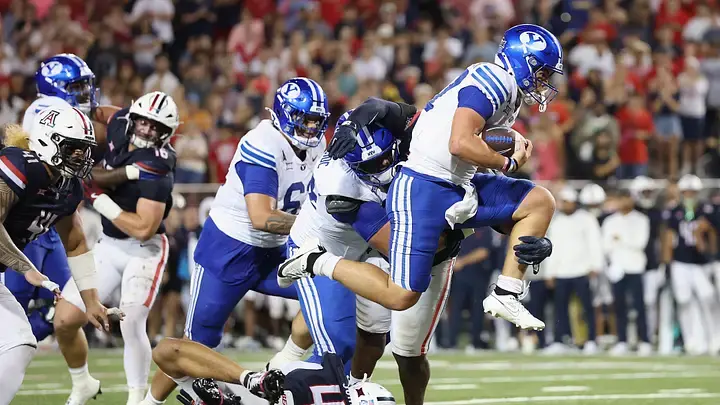
BYU @ Arizona


Recent History & Storylines
These two met last season in Provo where BYU won 41–19, forcing 4 Arizona turnovers and pulling away after halftime. That game set the tone for BYU’s hot start in 2024 and is a useful lens for this week: Arizona can move it, but mistakes against BYU are costly.
Game Details
When/Where: Saturday, Oct. 11, 6pm MDT - Arizona Stadium
TV: ESPN 2
Line: BYU -2.5
Context: BYU 5–0 (2–0 Big 12); Arizona 4-1 (1–1 Big 12). Both teams arrive with momentum. BYU handled West Virginia behind a balanced offense and a stout defensive effort, with most of WVU's points coming on very short fields. Arizona demolished Oklahoma State, with Noah Fifita posting one of the league’s top QB stat lines last week.
Arizona at a Glance
Arizona is riding high after its most complete win of the year, a 41-13 dismantling of Oklahoma State that showed off what this team wants to be: fast, efficient, and dangerous through the air. They’ve now topped 30 points in four of five games, and at home the Wildcats’ offense has looked crisp behind junior quarterback Noah Fifita, who’s settled into the conference’s upper tier of accurate passers.
Arizona’s offense runs through Fifita’s timing and rhythm. Through six weeks, the Wildcats passing attack is #22 in the country in yards per game at 286.2 yards, leaning heavily on quick reads and slot spacing to stay ahead of schedule. The run game has been serviceable, mostly as a complement to the pass, with an additional 144.4 yards on the ground. The wide-receiver trio of Tre Spivey, Luke Wysong, and Chris Hunter gives Arizona multiple vertical threats and OC Brennan’s scheme spreads defenses horizontally before attacking up field.
Defensively, Arizona is volatile but opportunistic. The Wildcats’ havoc rate (26 percent of plays) is elite - 2nd in the country. They create negative plays with edge blitzes and disguised pressures. There aren't many weaknesses in this defense - their lone loss took turnovers and explosive plays through the air.
The BYU Side
Season to Date
Five wins, and a profile is becoming clear: efficiency and composure. BYU has played veteran football; staying on schedule, winning the hidden-yardage game, and mostly avoiding self-inflicted wounds. Through six weeks, the Cougars own one of the most balanced profiles in the Big 12: top-25 offensive success rate (48.8 %), positive PPA differential, and a defense that ranks among the league’s stingiest on passing downs.
The Cougars offense started conservative through the first couple of games against FBS opponents and has steadily been opening the playbook up during conference play. The offense averages 0.35 PPA per play with a nearly even pass-run split. QB Bear Bachmeier has been remarkably efficient (73.1 QBR, 34th nationally) while spreading the ball around — Chase Roberts and Parker Kingston headline a group that produced 11 plays of 20+ yards last week alone, with TE Carsen Ryan also being a big part of the offense. The ground game has been steady behind LJ Martin and a steady rotation of backs behind him, combining for over 1,100 yards through six weeks with a 91 percent power success rate; BYU converts short yardage better than nearly anyone in the Big 12.
BYU’s defense allows just 37.9 percent success rate and a -0.022 PPA overall, with negative EPA against both run and pass. Opponents have managed only 3.0 yards per carry on standard downs, and the Cougars have generated 17.7 percent havoc, primarily from the front seven. If there’s a model for steady pressure without busts, this is it.
Last Game: BYU 38, West Virginia 24
BYU set the tone early and never really let it go. The opening quarter was all tempo and explosives: the defense jumped a route near midfield and Therrian Alexander III ripped the return down to the one-yard line, and on the very next snap Parker Kingston tapped it in for 7–0. A few minutes later, BYU dialed up a screen that turned into a track meet—Bear Bachmeier to Kingston for 54 yards—and it was 14–0 in a blink. In the second quarter the Cougars doubled down on the vertical stuff: a two-play, 89-yard drive capped by Bachmeier’s 85-yard strike to Chase Roberts flipped the field and broke WVU’s leverage. From there BYU leaned into its balance, mixing patient runs with play-action shots and forcing West Virginia to chase.
It wasn’t spotless - three turnovers kept the door cracked and gifted WVU short fields - but every time the game asked for an answer, BYU had one. Bachmeier was sharp and efficient, posting a career-high 351 passing yards on 18-of-25 with a rushing score, while Roberts (161) and Kingston (111) did most of the damage outside. Despite early struggles moving the ball on the ground, LJ Martin had a solid game, punching in two touchdowns and giving the Cougars the short-yardage answers they needed.
The fourth quarter brought the one real stress test: WVU marched 12 plays and 74 yards to BYU’s one, but the defense bowed up and turned them away on downs. After a night of explosives and counterpunches, that stand was the last word. BYU managed the rest of the clock and closed out a game that felt controlled from the first punch to the final kneel.
Advanced Numbers Snapshot (season-to-date)

More detailed definitions of all terms are available in the Glossary.
Matchup Three Ways
1) BYU Offense vs Arizona Defense

Arizona’s havoc rate (26%) jumps off the page, but BYU’s 91% power success and overall passing/rushing success leads to long, methodical drives. The Cougars win by staying on schedule, not chasing explosives.
Bachmeier’s efficiency (73.1 QBR, +0.35 PPA) meets an Arizona defense that thrives on pressure but has been vulnerable to precision throws between the hashes.
Expect the running backs to struggle to find holes as Arizona brings heavy pressure, daring Bear to beat them over the top. If BYU’s O-line holds serve and avoids early-down losses, the Wildcats’ blitz looks turn into windows—this matchup favors rhythm and control.
2) Arizona Offense vs BYU Defense

Fifita’s accuracy and Arizona’s 43% pass success rate test BYU’s secondary, but the Cougars’ 37.9% defensive success rate allowed and negative pass PPA make them one of the toughest defenses in the league to sustain drives against.
BYU’s front has quietly limited opponents to 2.5 line yards per rush and forces true passing downs—exactly where Arizona’s efficiency dips.
The battle comes down to explosives: Arizona hits on 14% of plays for 20+ yards, but BYU has allowed very few this season. If the Cougars keep the ball in front, their advantage on standard downs should hold.
3) Hidden Yardage & Situations
Turnovers: BYU +5 vs Arizona +4—both good, BYU a tick better.
3rd downs: BYU O 41% vs Arizona D 26% allowed - strong advantage Arizona, though BYU has been very successful on 4th down and short.
Penalties: BYU (35/292) must clean it up on the road; Arizona (30/250) is slightly better.
Field position/line yards: Arizona’s defensive line-yards (2.12) are strong; BYU must stay ahead of the sticks to avoid Arizona’s pressure packages.
Keys to the Game (BYU)
Protect Bachmeier - Pressure is Arizona’s dynamite; neutralize the rush, the rest follows.
Limit Fifita’s Explosives - Arizona’s WRs can flip fields, they have real playmakers here. They don't drive the ball well without big plays.
Red-Zone Efficiency - Field goals won’t cut it; BYU’s short yardage advantage needs to show up and translate to touchdowns.
Prediction
Both teams are trending up, but BYU’s steadier efficiency metrics, turnover discipline, and red-zone advantage make the Cougars the more complete outfit right now. Expect physical drives, limited possessions, and a defense-first tone.
BYU 24, Arizona 17


Comments